New White Paper: From Burnout to Performance (Part 1)

That matters because burnout is not just a “wellbeing” issue. It is a signal that the demands placed on people are exceeding the recovery, meaning, connection, agency, and system support available to them.
The biology is real. Chronic stress research describes how repeated adaptation without adequate recovery creates cumulative physiological “wear and tear,” often called allostatic load. A 2024 integrative review found consistent links among occupational stress, burnout, work environment, and allostatic load, while noting that measurement methods still vary.
The takeaway for leaders is direct: resilience cannot be delegated to individuals alone. It has to be practiced by people, modeled by managers, and designed into culture.
Part 1 of this series made the case that energy is a missing metric behind performance, risk, and retention. But energy alone is not enough. Energy without resilience is unstable; under pressure, it gets depleted fast.
Resilience is the capacity to recover, reorient, and grow under pressure. It is not endurance. Endurance asks people to keep going. Resilience asks whether people can keep adapting without losing health, judgment, agency, purpose, or connection.
In practice, resilience is built through four interdependent capacities:
When those four capacities are weak — or when the work system overwhelms them—burnout becomes predictable. That is the real leadership issue. Burnout is not only a personal health concern; it’s also data about the operating system of work.
The Human Adaptation Gap is the distance between external demand and human adaptive capacity. AI, digital acceleration, labor shortages, rising complexity, and constant change are increasing the pace of work. But humans are not machines. The advantage to humans now is not speed; it’s judgment, creativity, meaning-making, ethical prudence, connection, and recovery.
Research demonstrates that resilience can be cultivated. A 2025 systematic review of resilience-based workplace interventions found that most interventions had positive effects, even though definitions and measures varied. The leadership message is clear: resilience is trainable, observable, and designable.
Self-leadership begins with noticing. People need the ability to recognize depletion, regulate attention and emotion, reconnect to purpose, and choose behavior under pressure. Purpose is not inspiration on a poster. In the science of psychological wellbeing, purpose in life is treated as a meaningful dimension of functioning and is linked to resilience-related health and adaptation outcomes.
Leaders should not ask teams to “be resilient” while leaving the work system unchanged. They create the conditions for resilience through clarity, prioritization, recovery norms, meaningful recognition, relational trust, and psychological safety. In a 2024 study of 621 nurse practitioners, psychological safety was associated with better work environment perceptions and lower burnout.
A resilient culture is not one where people tolerate endless urgency. It is one where the system absorbs change, recovers, learns, and keeps people connected to meaning. That shows up in workload planning, decision rights, escalation pathways, manager routines, recovery norms, recognition, and measurement.
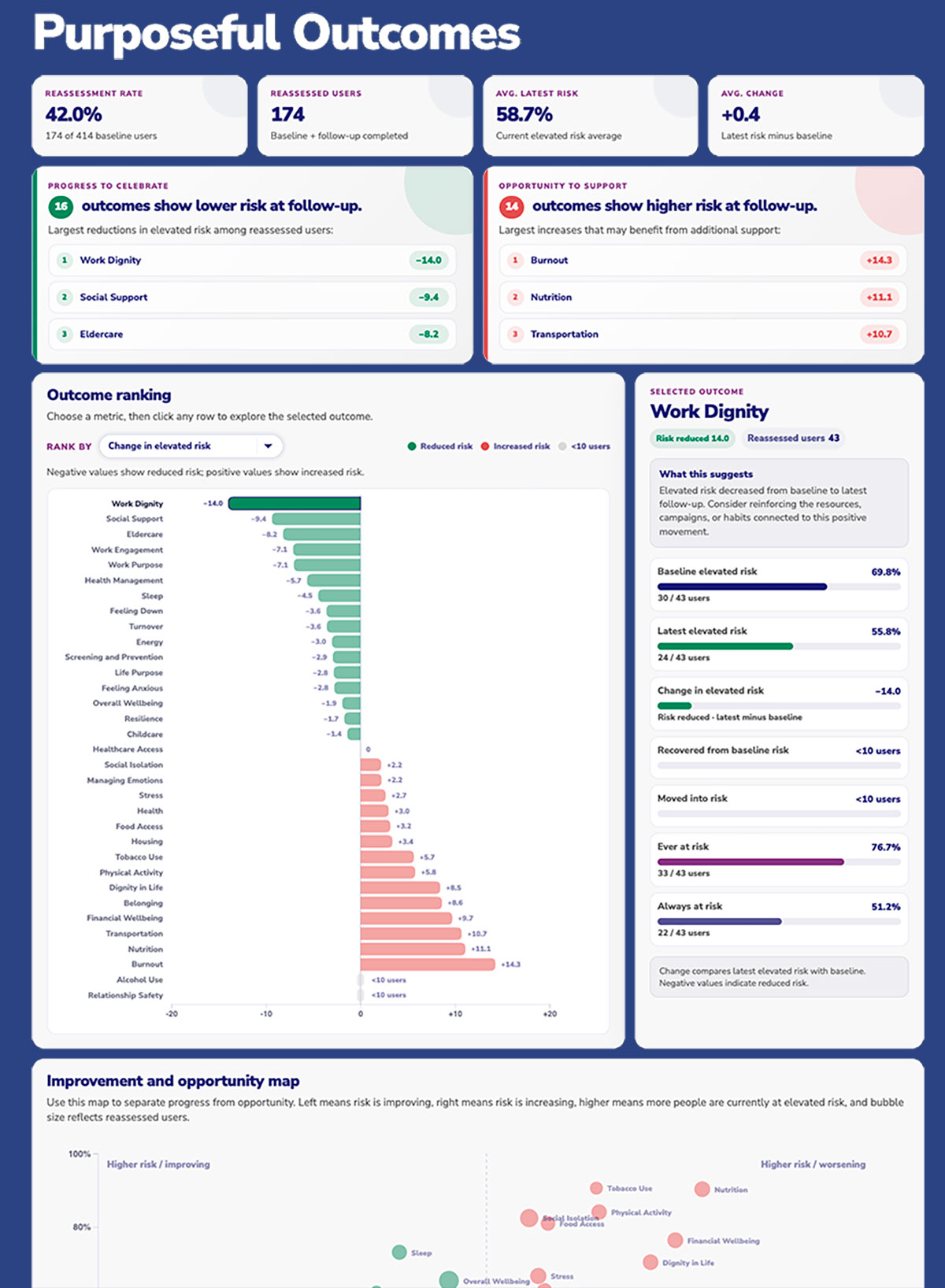
Kumanu outcomes help connect the evidence base to applied implementation. In client and platform data, purpose-centered wellbeing has been associated with improvements in retention intent, burnout risk, resilience, emotional self-regulation, purpose at work, engagement, anxiety, and depression risk.
Organizations have experienced the following improvements within 90 days of using the Kumanu platform, which includes the Purposeful app:
Publicly reported Kumanu figures include improved retention intent among elevated-risk users, reduced work burnout risk, improved sense of resilience, improved purpose in life and purpose at work, and improved ability to self-regulate emotions among baseline-risk participants.
If You Lead People: 5 Moves You Can Make in the Next 14 Days
Start small. The goal is not another program. The goal is to change the routines that shape energy, recovery, meaning, and adaptation.
Energy is the starting point. Resilience is what helps people sustain energy under pressure, recover from strain, and adapt to what comes next. But if organizations want performance that lasts, they need a human operating system — a culture —that protects recovery, strengthens purpose, builds connection, and makes resilience visible in the way work gets done.
In Part 3, we’ll share how to build one or strengthen the one you already have.

Chief Medical Officer
Robert Carr, M.D., MPH, is Chief Medical Officer at Kumanu and former President of the American College of Preventive Medicine. A nationally recognized leader in population health and executive coaching, he brings decades of clinical, corporate, and academic experience to advancing purpose-centered wellbeing.
Full BioSubscribe for the latest research, tools, and updates to elevate your people strategy.


